What is snapping and centering?
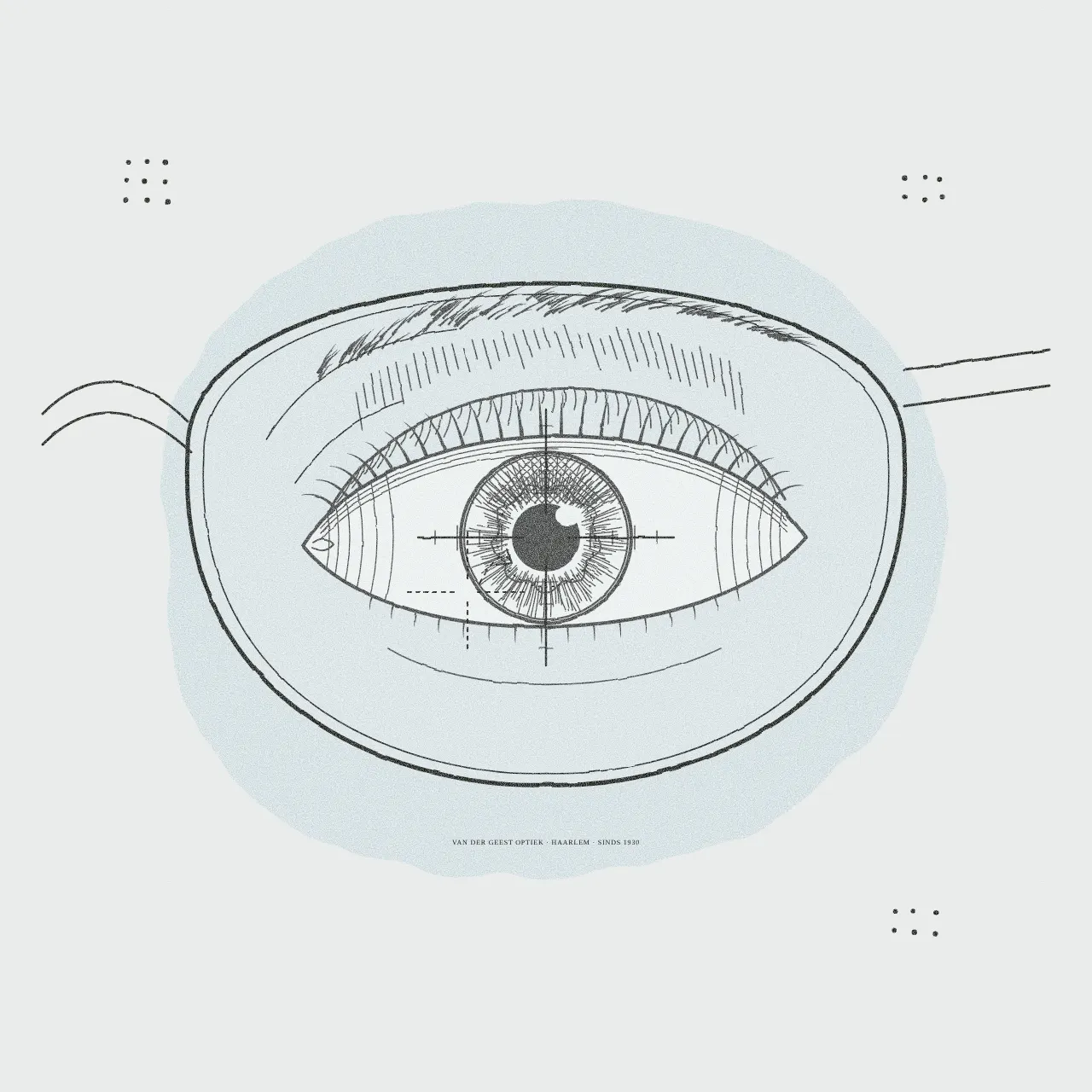
Every eyeglass lens has an optical center: the point where your vision is sharpest and most comfortable. When centering the lenses, we ensure that this point is positioned exactly in front of your pupil, even before the lenses are ground. “Marking” is the technical term for measuring and marking that spot. We assess how the frame fits on your face and determine the exact position of your eyes behind the lenses. Using those measurements, we grind the lenses so that the optical center is positioned correctly within the frame.
Your pupillary distance—the distance between your pupils—is an important measurement, but not the only one. Your face is rarely completely symmetrical, so we measure the distance for each eye, starting from the center of your nose. In addition, the eye height and the position of the frames on your face are needed, and these depend on the frames you choose. If you only provide your pupillary distance—for example, when ordering glasses online—those measurements will be missing. Therefore, the best way to measure for properly centered glasses is with the chosen frames on your nose.
What happens if a glass is out of place?
If the optical center isn’t positioned exactly in front of your pupil, the lens acts like a small prism. A prism bends light, causing you to see what you’re looking at in a spot that’s slightly different from where it actually is. Your eyes automatically correct for this: they turn slightly inward, outward, upward, or downward to create a single sharp image. The stronger your prescription, the greater this effect. With a low prescription, a difference of a few millimeters is often barely noticeable, but with a higher prescription, the same difference can be quite noticeable. The direction matters, too: a lens that’s positioned slightly too high or too low is harder for your eyes to compensate for than one that’s slightly off to the side.
Your eyes can often compensate for a minor defect, but it takes effort, especially if you wear your glasses all day. People may notice, for example:
- Your vision isn't as sharp as it should be, even though your prescription is correct.
- Your eyes tend to get tired more quickly, especially at the end of the day.
- You have a pulling sensation behind your eyes or are experiencing a headache.
- It's hard to get used to your new glasses.
Do you recognize this with your current glasses? Then stop by, and we’ll work together to see if your lenses are right for your eyes. Sometimes the problem lies in your prescription, in which case it’s a good idea to have your eyes checked. Good to know: sometimes a prism is intentionally incorporated into a lens, as prescribed by an ophthalmologist or orthoptist. That’s different from a lens that’s accidentally misaligned.
This is how we take measurements, including for multifocal lenses
In our store, we use a Nikon digital eye-measuring machine. You put on your new frames and look relaxed into the machine. In less than forty seconds, it takes precise measurements:
- your interpupillary distance for each eye;
- the viewing height per eye;
- the distance between the glass and the eye;
- how far the frame is angled in front of your eyes;
- the curvature of the frame;
- your natural posture;
- your reading distance.
With multifocal lenses, centering is even more critical. These lenses have zones for distance, intermediate, and near vision that gradually blend into one another and are narrower at the edges. If the lens is even a few millimeters too high or too low, you’ll end up looking through the wrong part and will have to constantly adjust your head position to see clearly. That’s why, for multifocal lenses, we measure the entry height for each eye separately, and we also take your reading distance and head position into account.
We use those measurements to get to work in our own lens-grinding shop. This allows us to grind the optical center exactly where it fits your eyes. After mounting the lenses, we double-check the centering, and when you pick up your glasses, we adjust them to ensure the lenses stay in the right place.
Frequently Asked Questions About Centering Eyeglass Lenses
The optical center is the point where your vision through the lens is sharpest and most comfortable. When centering the lens, we ensure that this point is positioned exactly in front of your pupil.
In that case, the lens acts like a small prism. Your eyes have to work harder to produce a single sharp image. This can feel like eye strain or blurred vision. The stronger your prescription, the greater the effect.
Not quite. In addition to your pupillary distance for each eye, we also need the eye point and the position of the frames on your face. It's best to measure these dimensions while wearing the frames you've chosen.
Every pair of frames fits your face differently. The height, the distance from your eyes, and the angle of the lenses vary from frame to frame. That’s why we always take measurements using the frames you choose.
Less than forty seconds. Put on your new glasses and look relaxed into the measuring column. That's all you need to do.
Want to make sure your glasses are the right fit for your eyes? Schedule an appointment through the online calendar on our contact page, call us at 023 5254 131, or stop by our location at Generaal Cronjéstraat 86 in Haarlem.
No rights may be derived from the information on this page or from any apparent errors or typos. The information is general in nature and is not a substitute for medical advice. Are you experiencing eye problems? If so, please contact your family doctor.