What types of eyeglass lenses are there?
There are roughly five types of eyeglass lenses, and each type has its own advantages. Which one suits you best depends on your prescription, your age, and what you mainly use your glasses for. That’s why we always start with an eye exam and a thorough consultation. That way, we can work together to choose the lens that fits your daily life.
- Single-vision lenses: a single prescription across the entire lens, for distance or near vision, like custom reading glasses. This is the most popular lens option.
- Multifocal lenses: multiple prescriptions in a single lens, with no visible line. You can see at a distance, at intermediate distances, and up close with a single pair of glasses. This is often the choice for people age 45 and older, when reading becomes more difficult due to presbyopia.
- Bifocal lenses: two prescriptions in a single lens, with a visible reading segment at the bottom. Less common, but still the most comfortable option for some people.
- Office or computer glasses: provide clear vision at reading distance and at the distance of your computer screen. Ideal if you spend a lot of time at the computer.
- Reading glasses: single-vision lenses designed for reading distance, for people who only need help seeing up close.
Are you trying to decide between two types of eyeglass lenses? Then we'll just let you experience the difference for yourself. That way, you'll know exactly what to expect beforehand.
Plastic or mineral glass, and what does the index mean?
Most eyeglass lenses are made of plastic these days. That’s because plastic is lightweight and doesn’t break easily. This makes it suitable for any pair of glasses, including those for children and for use during sports. What’s more, plastic lenses can be treated with virtually any type of coating.
Mineral glass, on the other hand, is real glass. It is naturally very scratch-resistant and extremely clear. On the downside, it is heavier and can break if struck hard. For those looking for that clear, scratch-resistant look, we still offer mineral glass. Incidentally, the material is separate from the types of eyeglass lenses mentioned above: almost every type of lens can be made from different materials.
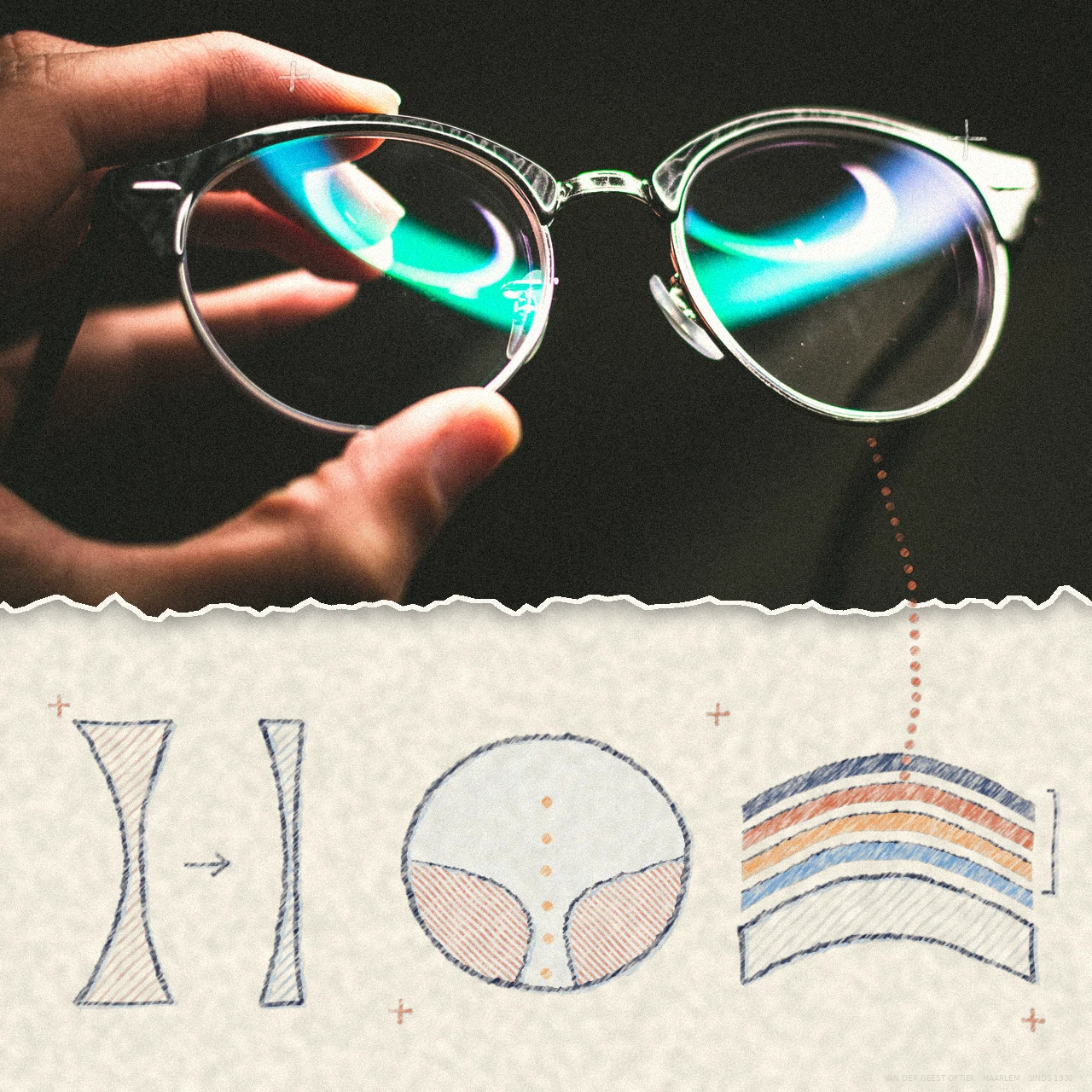
The index also indicates the thickness of the lens. Simply put: a higher index means a thinner and lighter lens for the same prescription. For plastic lenses, we offer indices of 1.5, 1.6, 1.67, and 1.74. If you have a high prescription, a thinner lens will make your glasses look better and be more comfortable to wear. For low prescriptions, a standard index is often perfectly fine. We’ll give you honest advice on what suits your prescription and frame.
Coatings and extras for your eyeglass lenses
A good coating also makes a big difference in how your glasses feel. You can choose a coating for all types of lenses. Plus, there are many more options than you might think. These are the options we offer most often:
- Anti-reflective and scratch-resistant coating: fewer reflections, a clearer image, and lenses that stay looking good longer.
- Blue light filter: a coating that filters out some of the blue-violet light emitted by screens. We’ll have an honest discussion with you to see if this is right for you.
- Photochromic lenses: they darken in the sun and return to their clear state indoors. This way, you have both eyeglasses and sunglasses in one.
- Prescription sunglasses: tinted or polarized, for clear vision in the sun without glare.
- Gradient and color: a shade that gets lighter toward the bottom, or glass in a color of your choice.
- Facet and brilliant cut: the edge of the lens is cut like a piece of jewelry, which looks especially beautiful on rimless glasses.
Actually, almost anything is possible upon request. If something isn’t technically feasible with your prescription or frames, we’ll discuss it with you beforehand and work together to find a good alternative. Want to know exactly what each coating does? Then check out our page on eyeglass coatings.
Personalized Glass Advice: What Should We Look at Together?
You notice the frames right away, but the lenses determine how well and how comfortably you see. Two pairs of glasses with the same prescription can feel very different, depending on the type of lens, the thickness, and the coatings. That’s why we take plenty of time to advise you on lenses. The optician who measured your eyes, our lens consultation specialist, or another staff member with extensive knowledge of lenses will tailor the options to what you need in your daily life.
We don’t start with the lenses—we start with you. What’s your daily routine like? Do you spend a lot of time working on a screen, drive a lot at night, enjoy reading, or exercise frequently? Do you wear your glasses all day or just for a specific task? Based on your answers and the results of your eye exam, we’ll work together to choose the type of lenses, the thickness, and the coatings. There’s no time limit on your appointment, so you can ask all your questions, and we’ll take the time to explain the differences.
Finally, the lenses must be positioned just right in front of your eyes. Using Nikon’s digital measuring stand, we measure your pupillary distance and eye height, among other things, to ensure that the optical center is in the correct position. Read why centering is so important.
Eyeglass Lenses from Haarlem: Advice, Nikon, and Our Own Lensing Facility
Our main supplier of eyeglass lenses is Nikon. Nikon is known for its sharp, clear lenses and durable coatings. We also offer a selection of many other reputable brands and high-quality basic lenses. This way, we can always find a lens that suits both your eyes and your budget. Our team takes the time to show you the differences and explain what each lens can do for you.
We then grind your lenses in our own workshop in Haarlem. This allows us to handle everything ourselves: from centering to the final inspection. In addition, we can often fit new lenses into your existing frames. Our lenses come with a 2-year warranty, as described in our terms and conditions.
The price of eyeglass lenses depends on your prescription, the type of lens, the index, and the coatings you choose. That’s why we always discuss the costs with you in advance, so you’ll never be faced with any surprises.
Frequently Asked Questions About Eyeglass Lenses
That depends on your prescription, your age, and how you use your glasses. During the eye exam and lens consultation, we'll go over these factors together, and we'll take the time to explain your options to you.
Plastic is lightweight and doesn't break easily. Mineral glass is real glass: very scratch-resistant and clear, but heavier and more fragile if struck hard.
Not always. With a high prescription, thin lenses make your glasses look better and feel lighter. With a low prescription, you can barely tell the difference, so a standard index is often just fine.
That's often the case. We grind the lenses in our own workshop. First, we check to see if your frames are still in good condition, and then we discuss what's possible.
That depends on your prescription, the type of lens, the refractive index, and the coatings. We always discuss the price in advance so you know exactly what to expect.
New eyeglass lenses come with a 2-year warranty against material and manufacturing defects under normal use. You can find the exact details of what the warranty covers in Article 12 of our Terms and Conditions. We’ll be happy to assist you even after that.
The optician who examined your eyes, our lens consultant, or another staff member with extensive knowledge of lenses. We’ll take all the time you need; there’s no maximum appointment length.
No. You choose the coating when the lenses are being made; it can't be applied afterward.
Wondering which types of eyeglass lenses are right for you? Schedule an appointment for an eye exam and lens consultation in Haarlem, or feel free to stop by at Generaal Cronjéstraat 86 with no obligation. We’d be happy to take the time to help you.
No rights may be derived from the information on this page or from any apparent errors or typos. The information is general in nature and is not a substitute for medical advice. Are you experiencing eye problems? If so, please contact your family doctor.