What is presbyopia?
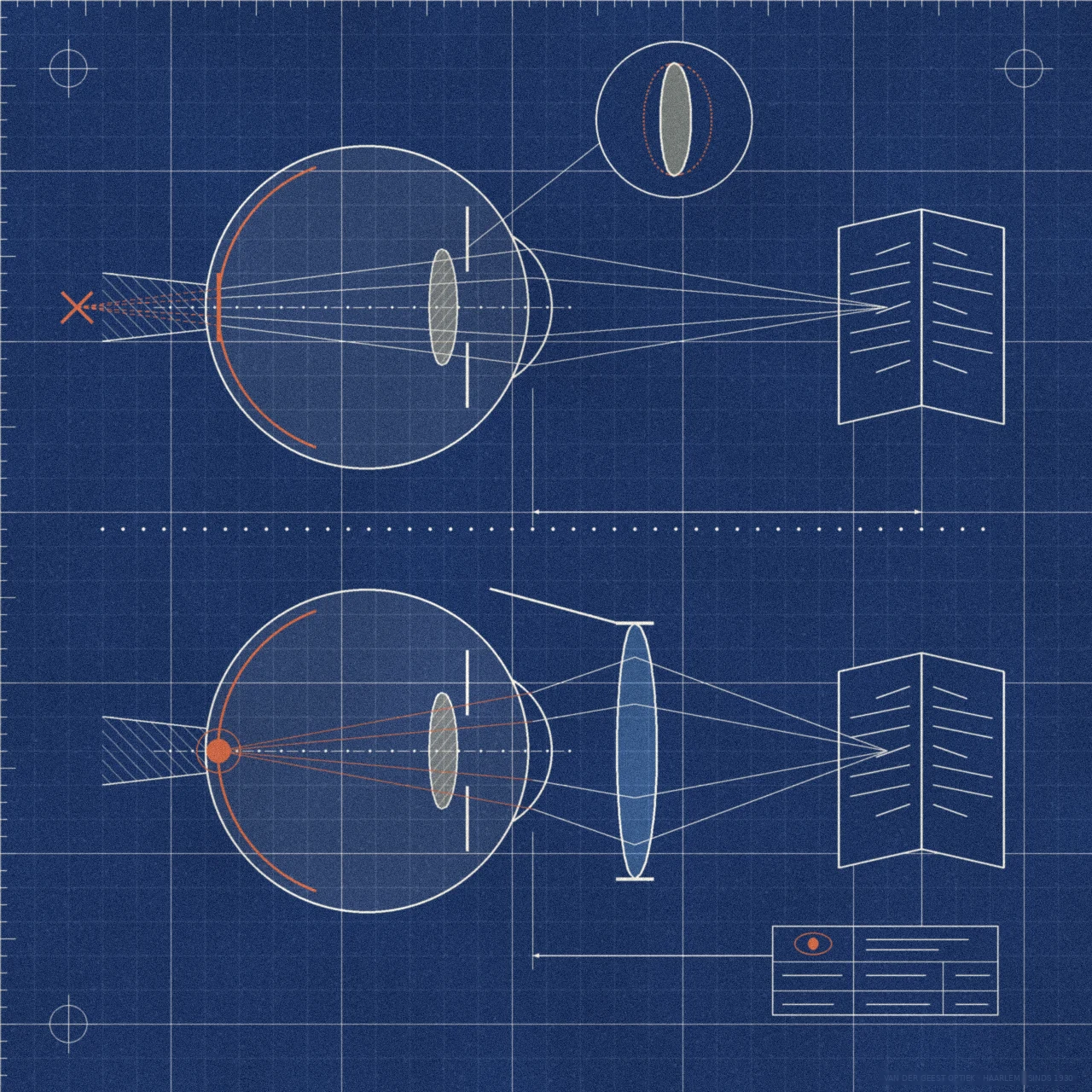
Age-related farsightedness (presbyopia) means that your eyes have trouble focusing on close objects. Inside your eye is a lens that changes shape when you shift your focus from far away to close up. As you age, that lens becomes less flexible, making it increasingly difficult to focus at reading distance. You usually start to notice it between the ages of 40 and 45, and it gradually worsens until around age 60. It’s completely normal and happens to everyone, even if you’ve always had good vision. It is, however, different from regular farsightedness, which is often present from a young age due to the shape of your eye.
You can often recognize presbyopia by these kinds of signs:
- You keep holding your phone, the newspaper, or a book farther and farther away. Your arms seem too short.
- You need more light to read.
- Small print on packaging or a menu becomes blurry.
- After reading or doing detailed work, your eyes feel tired.
- With your glasses, you can see well from a distance, but things up close aren't as clear.
What can you do about presbyopia?
Presbyopia cannot be reversed, but it can be effectively managed. The solution that’s right for you depends on your eyes and your daily activities:
- Custom reading glasses: for near vision only, with the correct prescription for each eye. Lenses starting at €59 per lens.
- Multifocal glasses: one pair of glasses for distance, intermediate, and near vision, so you don’t have to switch between them. Lenses starting at €115 per lens. Learn more about multifocal lenses.
- Workplace glasses (desk or indoor glasses): for people who spend a lot of time at a desk or in front of a computer screen. They provide clear vision at reading and screen distances, as well as indoors up to a few meters away.
A pair of ready-made reading glasses from the drugstore works just fine as a spare pair or a temporary solution. Keep in mind, however, that both lenses have the same prescription strength and that they do not account for astigmatism or the distance between your eyes. If your eyes don’t see equally well, reading can become tiring more quickly as a result. Read more about the difference between ready-made and custom-made glasses. You can learn more about the different types of lenses under “Eyeglass Lenses,” and see how much a complete pair of glasses costs in our overview of eyeglass prices.
Eye Exam: How We Determine Your Reading Prescription
During an eye exam, a certified optician will measure your distance and near vision. We’ll also ask about your reading distance and your daily activities so that our recommendations are tailored to your situation. The eye exam is free if you purchase glasses, eyeglass lenses, or contact lenses from us, or if it turns out that you don’t need a vision solution or that we can’t help you further. A standalone eye exam costs €45. See also our pricing.
Please bring your current pair(s) of glasses to your appointment. Do you wear contact lenses? If so, please read the instructions on how to prepare for your eye exam first.
Frequently Asked Questions About Presbyopia
You usually start to notice it between the ages of 40 and 45. After that, it gradually worsens until you're about 60. From then on, your reading ability often remains fairly stable.
No. Presbyopia is a natural part of the aging process of your eyes and cannot be reversed. However, it can be easily corrected with reading glasses, multifocal glasses, or computer glasses.
No, reading glasses don't change anything about your eyes. It may feel that way sometimes, though, because you get used to seeing clearly, and the difference becomes more noticeable without the glasses.
As soon as reading becomes more difficult again, it's time for another eye exam. Between the ages of 40 and 60, your prescription gradually changes, so it's a good idea to get your eyes checked about every two years.
Having trouble reading? Stop by at 86 Generaal Cronjéstraat in Haarlem, call us at 023 5254 131, or schedule an appointment using the online calendar on our contact page.
No rights may be derived from the information on this page or from any apparent errors or typos. The information is general in nature and is not a substitute for medical advice. If your vision suddenly worsens, or if you experience eye pain or other symptoms, please contact your primary care physician.