What is farsightedness?
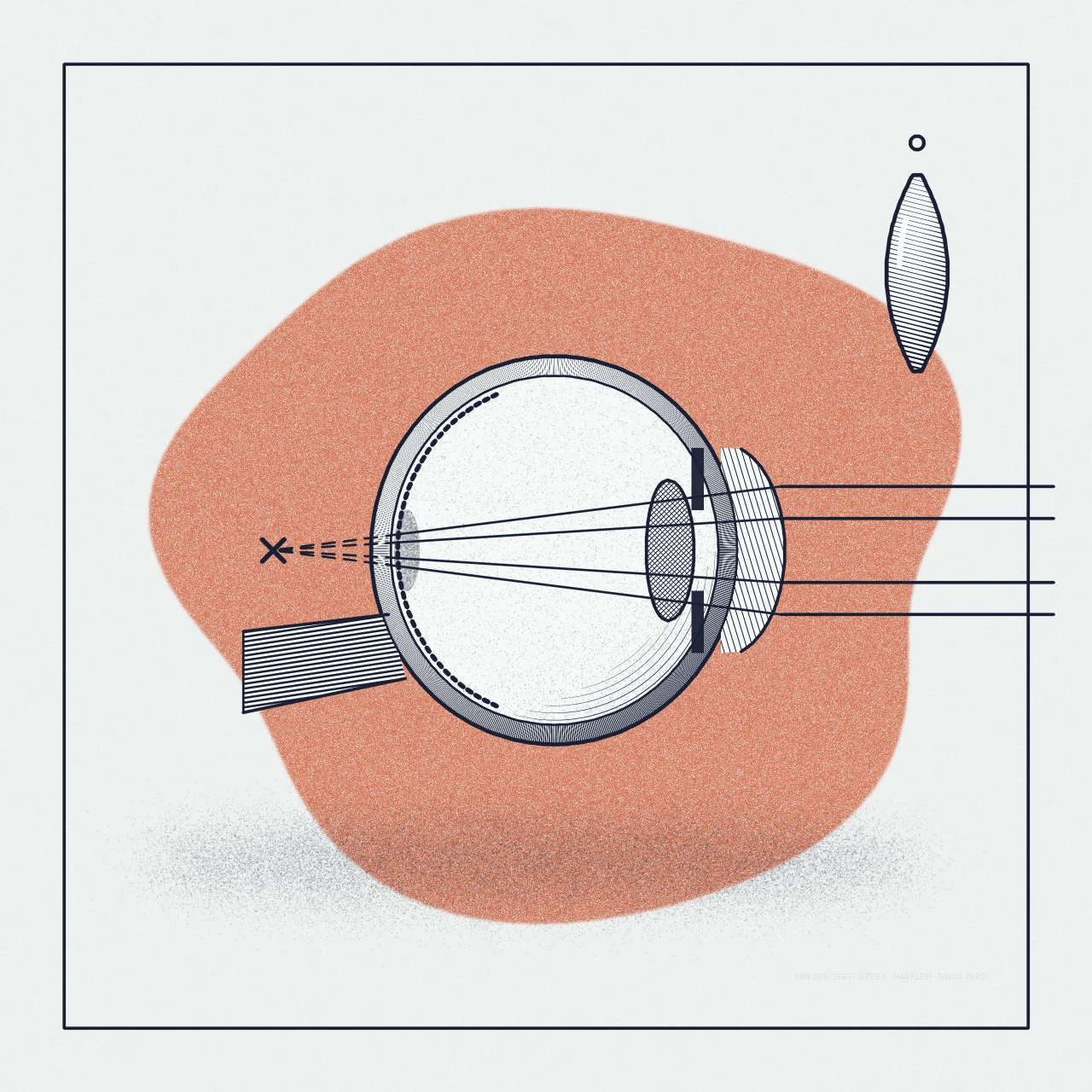
With farsightedness, also known as hyperopia, your eye is slightly too short, or the cornea refracts light just a little too weakly. As a result, the image falls behind your retina instead of on it. Your eye’s lens can compensate for this to a certain extent by focusing more sharply. This is why young people, in particular, often still see clearly—both far away and up close—but it requires constant effort on the part of their eyes.
On your eyeglass prescription, farsightedness is indicated by a power with a plus sign in front of it, for example, +1.50. Farsightedness is usually present from birth, due to the shape of your eye. It is therefore different from age-related farsightedness, also known as presbyopia: that develops between the ages of 40 and 45 because the eye’s lens becomes less flexible, and it happens to everyone.
How can you tell if you're farsighted?
Because your eyes can compensate for a lot, farsightedness doesn't always manifest as blurred vision. More often, you'll notice that your eyes get tired. Common signs include:
- tired or burning eyes after reading or working at a computer screen;
- headaches, especially at the end of the day;
- blurred vision up close, and—with a higher prescription—eventually blurred vision at a distance as well;
- trouble concentrating on close-up work.
Between the ages of 40 and 45, the eye becomes less and less able to compensate, because the lens of the eye also loses some of its flexibility. As a result, people with farsightedness often need reading glasses or multifocal glasses sooner. In children, farsightedness can sometimes be accompanied by strabismus. If you notice this in your child, contact your family doctor. In cases of severe farsightedness, there is also a slightly higher risk of developing an acute form of glaucoma.
Glasses, Contact Lenses, and Eye Exams
Farsightedness can be effectively corrected with glasses that have plus-power lenses. This eliminates the need for your eyes to strain to focus, making vision more comfortable. Sometimes you’ll need the glasses mainly for reading and working on a screen, and sometimes you’ll need them all day long; it depends on your prescription and age. Contact lenses are also an effective way to correct farsightedness.
During the eye exam, we measure your prescription for distance and near vision and discuss when it’s best for you to wear your glasses. Starting around age 9 or 10, we also examine children’s eyes ourselves; younger children are examined by their family doctor or an ophthalmologist, and we use the ophthalmologist’s prescription to create a pair of children’s glasses that fit properly. If you purchase glasses or contact lenses from us, or if it turns out that you don’t need a vision solution or that we can’t help you further, the eye exam is free of charge; you can find all prices in our rate schedule.
Frequently Asked Questions About Farsightedness
No. Farsightedness is caused by the shape of your eye and often develops from an early age. Presbyopia develops between the ages of 40 and 45 because the eye's lens becomes less flexible.
Your eye's lens can compensate for farsightedness to a certain extent by focusing more intensely. However, this takes effort, which causes your eyes to tire more quickly.
A positive prescription, such as +1.50, means you are farsighted. The higher the number, the more your eyes have to compensate without glasses.
That depends on your prescription and age. Sometimes glasses are needed mainly for reading and working on a screen. We'll discuss this after your eye exam.
Do you experience eye strain when reading? You can find us at 86 Generaal Cronjéstraat in Haarlem. Call us at 023 5254 131 or schedule an appointment through the online calendar on our contact page.
This information is general in nature and is not a substitute for medical advice. Van der Geest Optiek does not currently employ an ophthalmologist or a college-trained optometrist. As certified opticians, we will examine your eyes and, if in doubt, refer you to your primary care physician. No rights may be derived from the information on this page or from any apparent errors or typos.