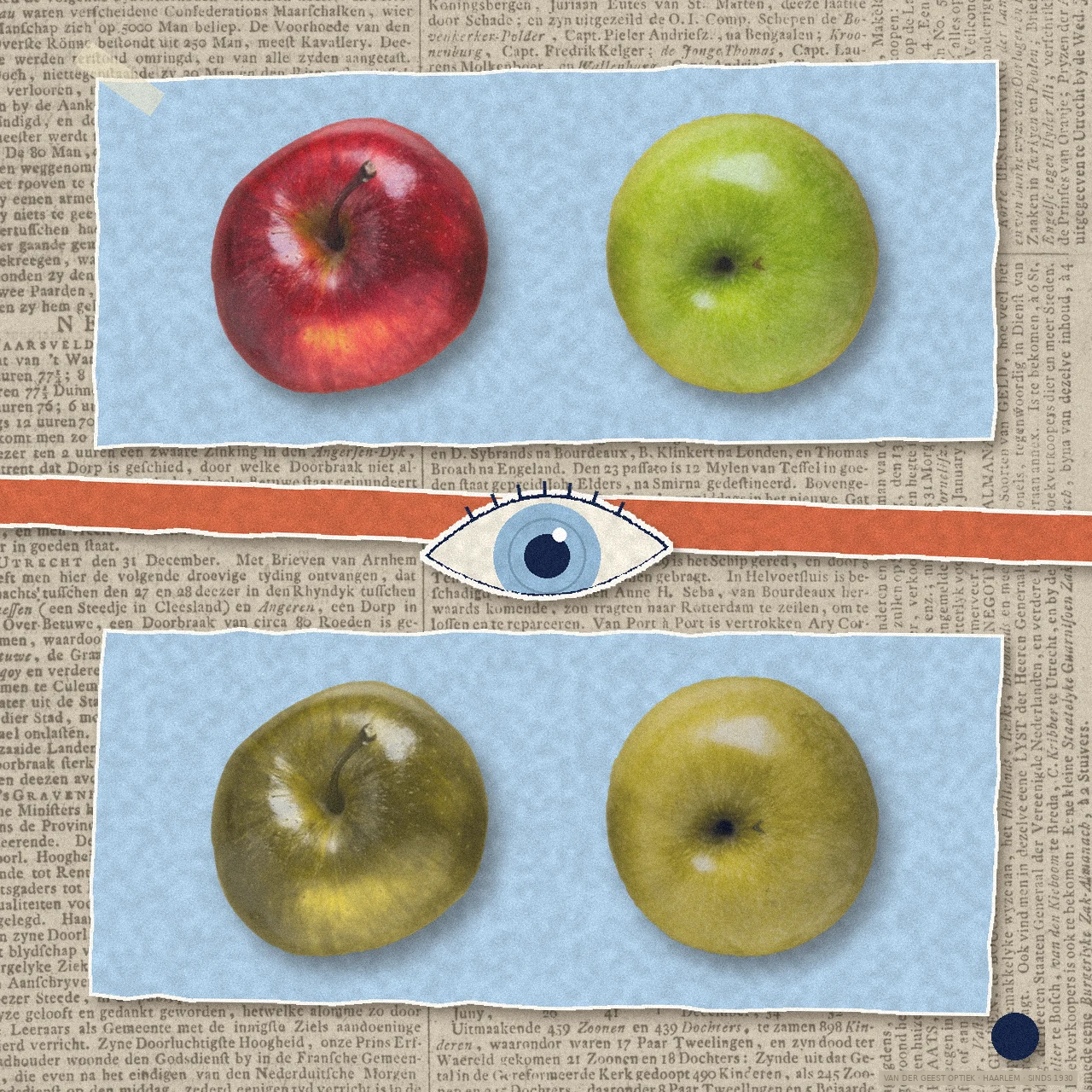
What is color blindness?
You see colors thanks to the cones in your retina. There are three types, each of which is particularly sensitive to red, green, or blue. Your brain combines the signals from these three types to create the colors you see. Learn more about how the eye works. In color blindness, one of these types of cones functions differently than normal, or that type is missing entirely.
The term “colorblind” is actually somewhat misleading. Most people with a color vision disorder can see colors, but have difficulty distinguishing between certain colors. We call this color weakness. In a more severe form, one type of cone is missing, so you see with two types of cones instead of three. Congenital color blindness is almost always red-green color blindness: red and green appear similar to one another. Being completely unable to see colors is very rare.
People with color blindness generally have normal visual acuity and are not particularly sensitive to light. The extent to which color vision is affected varies from person to person. Color vision in the dark is limited for everyone, by the way, because that’s when the rods take over. This has nothing to do with color blindness, but rather with night blindness.
Hereditary or acquired?
Color blindness is usually congenital. The genes for the red and green cones are located on the X chromosome. As a result, red-green color blindness is much more common in men than in women. In the Netherlands, it affects about 8 percent of men and 0.5 percent of women. A woman can be a carrier: she sees normally herself, but can pass on the predisposition to her sons. Congenital color blindness usually does not change over the course of one’s life.
In addition, there is an acquired form, which develops later in life. This can result from a disorder of the retina or the optic nerve and occurs equally often in men and women. In such cases, difficulty distinguishing blue and yellow is more common. With cataracts, colors may also appear paler, yellower, or browner because the eye’s lens becomes cloudy. If you notice that you see colors differently than you used to, this is different from congenital color blindness. See your family doctor about this.
A color test: How can you tell if you're colorblind?
Color vision is tested using special color charts, such as the Ishihara test. On such a chart, there is a number made up of colored dots. Someone with red-green color blindness will either not see a number at all or will read a different number. This test indicates whether red-green color blindness is present, but it does not specify exactly which type it is or how severe it is. Further testing is needed for that. Dutch ophthalmologists provide more background information on color vision and color blindness.
For children, the school health nurse can administer a color test starting around age 7—for example, if your child is having trouble learning colors or when choosing a field of study. According to the GGD, about 40 percent of people with color blindness are not yet aware of it by the time they graduate from high school. This is important because professions such as pilot, ship captain, and train engineer require good color vision. If you want to know how your child sees, read about eye exams for children.
Color blindness cannot be treated. It can be challenging in everyday life, such as when choosing outfits that go well together. Asking someone for help often solves this problem. In addition, there are special color-filter lenses that make it easier to distinguish between certain colors. They do not cure color blindness and do not work for everyone; you can ask us what options are available to you. An eye exam at our clinic focuses on your prescription and how clearly you see. If you have concerns about your color vision, please discuss them with your primary care physician.
Frequently Asked Questions About Color Blindness
Yes. The predisposition to red-green color blindness is located on the X chromosome. In the Netherlands, it affects about 8 percent of men and 0.5 percent of women.
With color blindness, you can see colors, but you have difficulty distinguishing between certain colors. In more severe cases, one type of cone cell is missing. Being completely unable to see colors is very rare.
Using special color charts with numbers made up of colored dots, such as the Ishihara test. For children, the pediatrician can perform this test; as an adult, you should discuss it with your primary care physician.
No, color blindness cannot be treated. Congenital color blindness usually does not change over the course of your life.
Do you have questions about your eyes or your glasses? You can find us at 86 Generaal Cronjéstraat in Haarlem. Call us at 023 5254 131 or schedule an appointment using the online calendar on our contact page.
This information is general in nature and is not a substitute for medical advice. Van der Geest Optiek does not currently employ an ophthalmologist or a college-trained optometrist. As certified opticians, we will examine your eyes and, if in doubt, refer you to your primary care physician. No rights may be derived from the information on this page or from any apparent errors or typos.