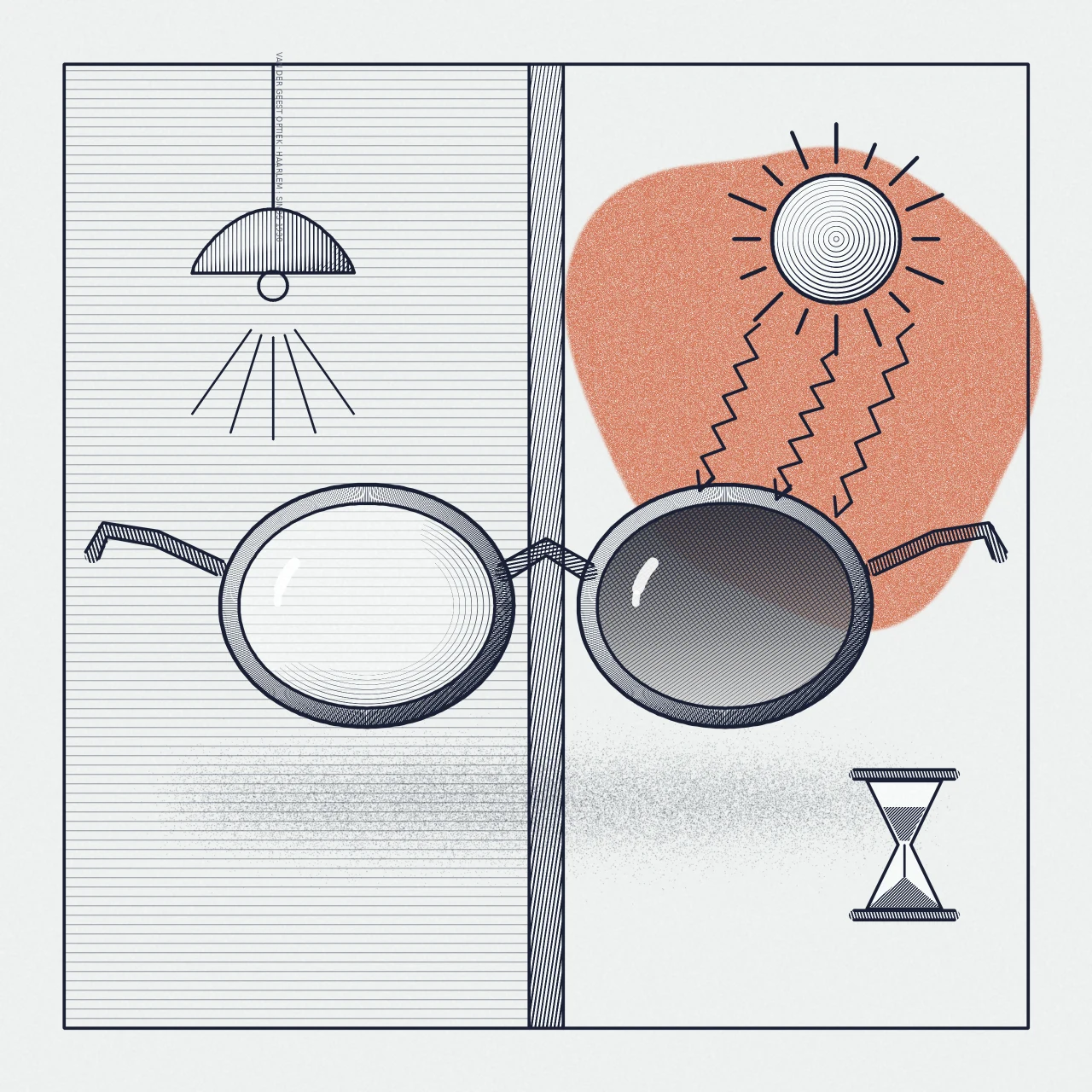
How do photochromic lenses work?
Photochromic lenses contain particles that react to UV light. When you step outside, the lenses darken within about a minute, and when you come back inside, they automatically lighten again. The lightening process is a bit slower and usually takes a few minutes. This way, you have both regular glasses and sunglasses in one pair, so you don’t have to keep switching them out.
How dark the lenses become depends on the amount of UV light and the temperature. On a cold, sunny day, they darken more than on a warm summer day. Furthermore, behind a car’s windshield, most photochromic lenses barely darken at all, because the windshield blocks a large portion of the UV light. Photochromic lenses are available in both single-vision and multifocal versions, in a variety of colors.
Who can benefit from photochromic lenses?
Photochromic lenses are especially convenient if you’re constantly going in and out and don’t feel like switching glasses all the time. For example:
- people who bike or walk a lot;
- anyone who is sensitive to bright light;
- anyone who doesn't want separate prescription sunglasses;
- children and adults who spend a lot of time outdoors.
There are also situations where prescription sunglasses are a better fit. If you drive a lot in the sun, photochromic lenses behind the windshield won’t get dark enough. And on the water, at the beach, or in the snow, polarized sunglasses are often more comfortable because they also eliminate glare. That’s why many people choose photochromic lenses for their everyday glasses and prescription sunglasses for vacations or driving.
Advice and Price
We’ll discuss whether photochromic lenses are right for you after your eye exam. Together, we’ll look at how you use your glasses, how much time you spend outdoors, and whether you drive a lot. You choose photochromic lenses when ordering new ones; it’s not possible to retrofit your current lenses with photochromic technology.
Tinted lenses increase the price per lens. We always discuss this additional cost in advance so you can decide for yourself. Read more in our guide, “How Much Do Glasses Cost?”, and about other layers and filters on the lenses in our section on eyeglass coatings. If you purchase your glasses from us, or if it turns out that you don’t need a vision solution or that we can’t help you further, the eye exam is free of charge.
Frequently Asked Questions About Photochromic Lenses
Hardly. The windshield blocks a large portion of the UV light. That’s why prescription sunglasses are often more comfortable for driving in the sun.
Outdoors, they go dark in about a minute. It usually takes a few minutes for them to become bright again.
No, you choose the tint when you have new glasses made. You can't do it afterward.
For everyday use, that's often the case. In the car, on the water, or in the snow, prescription (polarized) sunglasses are usually more comfortable.
Wondering if photochromic lenses are right for you? You can find us at Generaal Cronjéstraat 86 in Haarlem. Call us at 023 5254 131 or schedule an appointment using the online calendar on our contact page.
No rights may be derived from the information on this page or from any apparent errors or typos.