
Why Your Current Glasses No Longer Fit
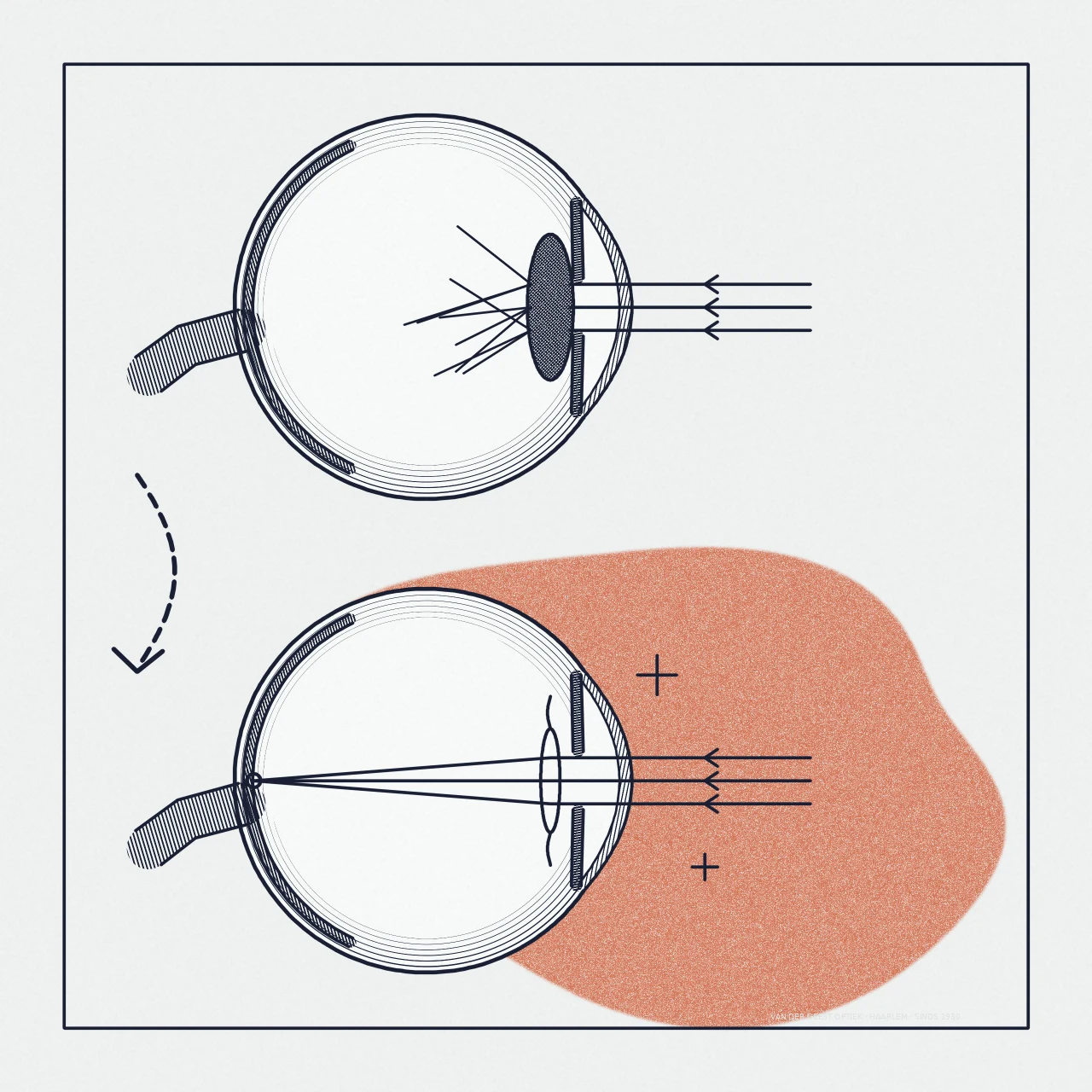
During cataract surgery, the ophthalmologist replaces the cloudy natural lens with a clear artificial lens. The prescription of that artificial lens is calculated in advance. Usually, the ophthalmologist chooses a standard artificial lens that focuses clearly at a single distance, often far away. As a result, your eye suddenly has a different prescription, meaning that the eyeglass lens for that eye no longer matches your vision. Your vision becomes less sharp, and your eyes don’t work together as well.
A standard intraocular lens cannot focus on different distances on its own. That’s why, after surgery, you’ll almost always need glasses for reading, using your phone, or doing other close-up work. The type of glasses you’ll need depends on your remaining prescription after surgery and how you use your eyes on a daily basis. You can read more about the condition itself on our page about what cataracts are and what they mean for your glasses.
Between surgeries: a glass of non-prescription liquor
Usually, the eyes are not operated on at the same time. There are often several weeks between surgery on the first eye and the second. During that time, the prescription for your eyes may differ significantly: the eye that has been operated on has a new prescription, while the other eye still has the old one. Your current glasses are not adjusted for this, which can make your vision feel blurry or cause eye strain.
A practical solution is a lens with no prescription, also known as a window lens or zero-power lens. Just before or immediately after the surgery, we replace the lens in the operated eye with a zero-power lens from our inventory in our own workshop. The lens in the other eye remains in place, so you retain your usual prescription in that eye. After surgery on the second eye, we do the same for that eye. This way, you can continue to wear your own frames until both eyes are ready for a new eye exam.
When should I get new glasses after cataract surgery?
After surgery, your eye needs time to heal. It’s only once your prescription has stabilized that it makes sense to have your permanent glasses made. Hospitals generally recommend waiting four to six weeks after surgery on the second eye, sometimes a little longer. Your ophthalmologist will let you know during your follow-up visit when your eyes are stable; always follow that advice. You can read more about recovery after surgery on Thuisarts.nl.
If your vision is stable, we’ll measure it again. If you’ve received a prescription from the hospital, we’ll use that as a starting point. If you don’t have a prescription, we’ll perform a complete eye exam at our store in Haarlem. The eye exam is free with the purchase of glasses, eyeglass lenses, or contact lenses, or if it turns out that you don’t need a vision solution or that we can’t help you further. A standalone eye exam costs €45.
Please bring the dates of your surgeries to your appointment, as well as the letter or referral from the hospital, if you have them. Also, read about how to prepare for your appointment.
Reading glasses or multifocal lenses: Which pair is right for you?
After the examination, we’ll discuss together which solution best suits your eyes and your daily activities. If your distance prescription is zero or nearly zero after surgery, and there is little or no astigmatism (a prescription that isn’t the same in all directions), then a pair of custom reading glasses is often sufficient. You’ll wear them only for close-up tasks, such as reading and using your phone.
If you want one pair of glasses for all distances, multifocal glasses are a good choice. The upper part of the lens contains your prescription for distance vision. Depending on your eye exam results, this could be a lens with no prescription, just a cylinder, a low prescription without a cylinder, or a low prescription with a cylinder. The lower part contains the additional prescription for near vision—the reading addition—with a gradual transition in between. This allows you to switch from distance to near vision without changing glasses.
The solution you choose will depend on your vision after surgery and your personal preference. Learn more about custom reading glasses or multifocal lenses. We always discuss the costs in advance; you can find an estimate on our page about the cost of glasses.
Frequently Asked Questions About Your Glasses After Cataract Surgery
Partially. The lens for the eye that underwent surgery usually no longer matches your new prescription. This isn't harmful to your eye, but your vision will be less clear with it. By using a non-prescription lens in that spot, you can continue to wear your existing glasses more comfortably in the meantime.
Usually four to six weeks after surgery on the second eye, sometimes a little longer. Your ophthalmologist will let you know when your eyes have stabilized.
You'll almost always need another pair of glasses for close-up vision, because a standard artificial lens doesn't focus on its own. These can be custom-made reading glasses or multifocal glasses.
That's not necessary. If you have a prescription, please bring it with you; we'll use that as a starting point. If you don't have one, we'll remeasure your eyes ourselves.