What are reading glasses?
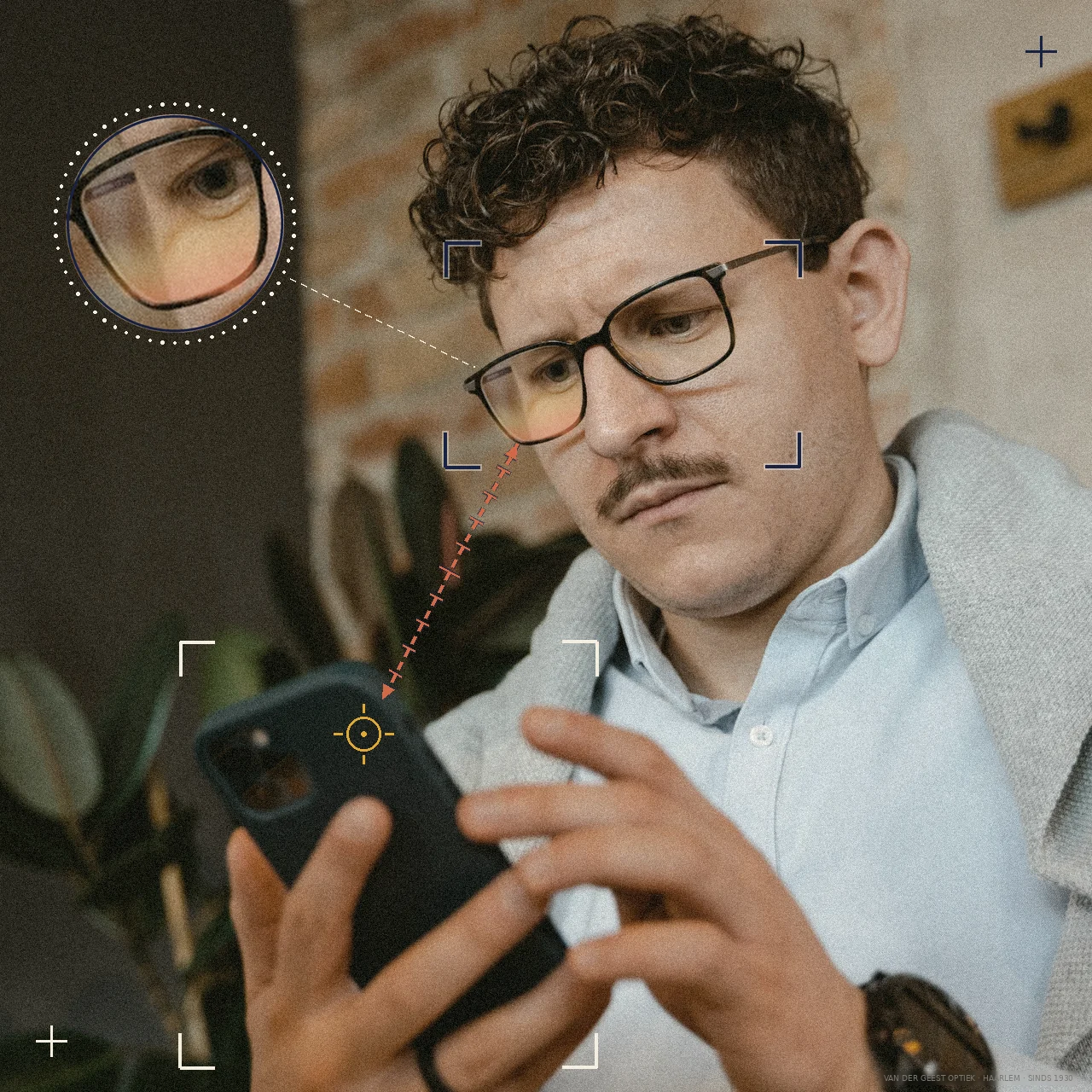
Lens with reading support are distance-correcting lenses that have a slight additional prescription in the lower portion for near vision. The transition is gradual, and there is no visible line in the lens. When you look straight ahead, you see clearly in the distance. When you look down at your phone, a book, or your laptop, the lens helps your eyes focus a little better.
The difference from a multifocal lens is that the additional prescription is very slight. A multifocal lens provides a full reading prescription for people with presbyopia. Lenses with reading support are intended for the years leading up to that, when you don’t yet need reading glasses but find it more difficult to see up close. As a result, you usually hardly have to get used to them at all.
Who are these glasses for?
They are primarily intended for adults between the ages of about 30 and 45 who spend a lot of time looking at things up close: people who are on their phones all day, read a lot, or work on a laptop. In these situations, your eyes have to constantly refocus at close range. As you get older, this gradually becomes more difficult, even though you don’t really notice that reading is getting harder until you’re around 40 to 45. By the end of the day, you may experience eye strain, a heavy feeling behind your eyes, or a headache.
Glasses with reading support can make close-up work a little more comfortable. They aren’t a cure-all: if your symptoms persist, we’ll also assess your prescription, your workspace, and your habits during the eye exam. Taking breaks remains important—for example, by following the 20-20-2 rule.
Phone, book, and laptop, but no separate screen
The extra correction is in the lower part of the lens and is tailored to reading distance: the distance to your phone, a book, or a laptop—about 40 to 45 centimeters. These glasses are not intended for use with a standalone monitor at a distance of about 70 to 80 centimeters. Such a monitor is often at eye level, causing you to look through the portion of the lenses designed for distance vision. If you spend a lot of time working at a standalone monitor, computer glasses are the better choice; we explain the different types there.
We’ll determine which solution is right for you after an eye exam. We’ll measure your distance and near vision and ask how you use your eyes throughout the day. Then, using the digital measuring station, we’ll determine exactly where the lenses should be positioned for your eyes. The eye exam is free with the purchase of glasses, eyeglass lenses, or contact lenses, or if it turns out that you don’t need a vision solution or that we can’t help you further. A standalone eye exam costs €45. The cost of the lenses depends on your prescription and your choices; you can find an overview on our page about the cost of glasses.
Frequently Asked Questions About Glasses with Reading Assistance
Reading glasses are only clear up close. Lenses with reading support are clear at a distance and provide a slight boost for near vision at the bottom, so you can wear them all day long.
Usually hardly at all, because the increase in strength is small and gradual.
No. For a screen that's 70 to 80 centimeters away, computer glasses are the better choice.
This is especially true for adults between the ages of about 30 and 45 who do a lot of close-up work. After the age of 40 to 45, reading glasses or multifocal glasses are often necessary.
Wondering if reading glasses are right for you? You can find us at Generaal Cronjéstraat 86 in Haarlem. Call us at 023 5254 131 or schedule an appointment using the online calendar on our contact page.
No rights may be derived from the information on this page or from any apparent errors or typos.